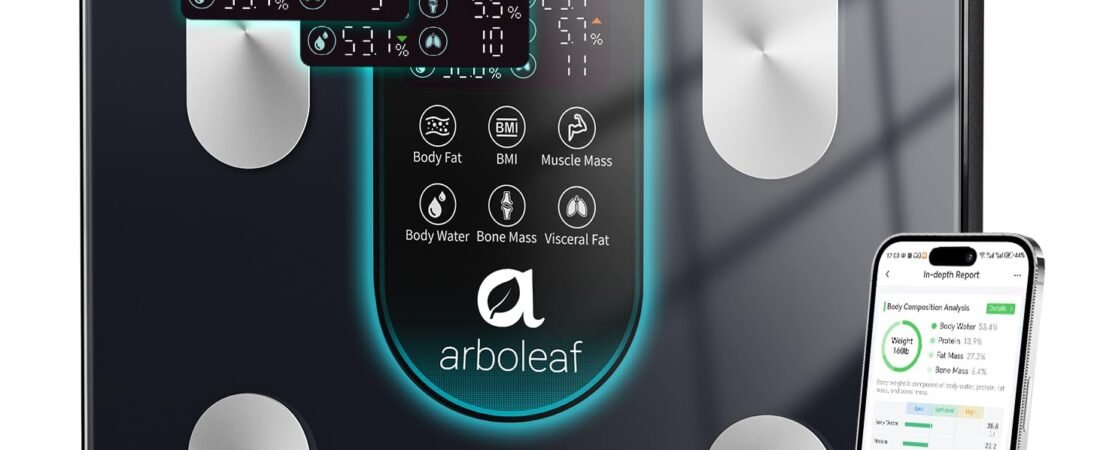
For many people, stepping on a bathroom scale is only the beginning of a health and fitness routine. Body weight can be useful for tracking long-term changes, but it does not explain everything happening within the body. Two people can have the same weight while having very different proportions of muscle, fat, body water, and other body-composition characteristics.
Smart body composition scales are designed to provide additional information alongside weight. The arboleaf Smart Scale for Body Weight with an 8-electrode design and handle takes this concept a step further by using both hand and foot contact points. Instead of relying only on measurements taken through the feet, the system is designed to collect impedance information through the upper and lower body and use that information to estimate body-composition metrics.
Arboleaf’s current smart-scale lineup describes its handle-equipped models as using dual-frequency bioelectrical impedance analysis, or DF-BIA, with eight hand-and-foot electrodes. The company’s current documentation also describes segmental analysis covering the arms, legs, and torso, with up to 50 body metrics available through the Arboleaf app.
That additional information can be useful for people who want to look beyond the number displayed on a traditional scale. At the same time, body-composition measurements from consumer smart scales are estimates rather than direct clinical measurements. Hydration, food intake, exercise, skin temperature, measurement conditions, and other factors can influence bioelectrical impedance readings.
This article explains how an 8-electrode smart scale works, what the handle adds, how it can be incorporated into a fitness or wellness routine, what the different measurements mean, and what users should consider when interpreting the results.
What Is an 8-Electrode Smart Scale?
A conventional digital bathroom scale generally measures body weight using sensors beneath the platform.
A smart body-composition scale can go beyond weight by using bioelectrical impedance analysis, commonly known as BIA.
BIA works by passing a very small electrical current through the body and measuring how the body responds to that current. Because different tissues have different electrical properties, the collected impedance information can be used by an algorithm to estimate characteristics such as body fat, muscle mass, and body water.
The arboleaf handle-equipped scale uses a different contact arrangement from a basic foot-only BIA scale.
The user stands on the scale while holding the connected handle. This creates contact points at both the hands and feet. Arboleaf describes its 8-electrode system as using hand-to-foot measurement for fuller whole-body analysis.
The result is not a direct measurement of every tissue compartment. Instead, the electrical impedance data is processed using an algorithm to generate estimates of body composition.
That distinction is important when interpreting the numbers.
Why the Handle Matters
The handle is one of the defining elements of this type of smart scale.
With a basic foot-only BIA scale, the electrical pathway is primarily measured through the lower body. An 8-electrode system adds contact points for the hands, allowing the measurement pathway to include the upper and lower body.
Arboleaf describes this as hand-to-foot analysis and uses it to support segmental measurements for areas such as the arms, legs, and torso.
This can provide a different perspective from simply stepping onto a scale.
For example, rather than receiving only an overall body-fat estimate, a compatible Arboleaf system can provide information about fat and muscle across different body areas through the app.
The handle therefore isn’t simply a grip for convenience. It is part of the measurement system.
Key Features
8-Electrode Measurement Design
The eight-electrode configuration uses contact points at both the feet and hands.
This allows the scale to collect impedance information through a larger portion of the body than a typical foot-only smart scale.
Arboleaf describes its current handle-equipped smart scales as using eight hand-and-foot electrodes for whole-body body-composition analysis.
The practical significance is that the measurement is designed to consider the upper body as well as the lower body.
Dual-Frequency BIA
Arboleaf’s current product information identifies dual-frequency bioelectrical impedance analysis, or DF-BIA, as part of its handle-equipped smart-scale technology.
Using more than one electrical frequency can provide additional impedance information compared with a single-frequency approach.
That additional information is processed by the scale’s algorithm to estimate body-composition characteristics.
It is worth remembering that the presence of DF-BIA does not make the resulting measurements equivalent to those obtained from clinical imaging or laboratory techniques. The technology is intended for consumer body tracking and trend monitoring.
Body Weight Measurement
Despite the additional technology, the basic function remains body-weight measurement.
Weight is still one of the easiest metrics to monitor over time, particularly when measurements are taken under reasonably consistent conditions.
For someone following a fitness program, weight can be considered alongside other measurements rather than used as the sole indicator of progress.
Body Fat Estimation
The system can provide an estimate of body-fat percentage through the Arboleaf app.
Body-fat percentage is different from body weight. It represents the estimated proportion of total body mass that consists of fat tissue.
Because BIA is influenced by hydration and other variables, a single reading should not automatically be treated as an exact measurement.
Looking at changes over time under similar conditions can provide more useful context.
Muscle Mass Estimates
The Arboleaf app can provide muscle-related measurements as part of its broader body-composition reporting. The company’s current product information lists muscle mass among the metrics available through its smart-scale ecosystem.
Muscle mass estimates can be useful when following a resistance-training program or changing eating and exercise habits.
However, users should avoid interpreting a small day-to-day change as a definite change in actual muscle tissue. Short-term fluctuations can result from hydration, glycogen, food intake, and other factors.
Body Water
Body-water estimates are another type of metric available through compatible Arboleaf smart scales.
This can provide additional context when interpreting body-composition readings.
Hydration is especially important because it can affect BIA measurements. Someone who measures after exercise, after drinking a large amount of water, or after becoming dehydrated may receive a different reading than they would under standardized conditions.
Segmental Information
One of the more interesting aspects of an 8-electrode design is segmental analysis.
Arboleaf describes its compatible smart scales as providing information for the arms, legs, and torso.
This can be useful for users who want to monitor how estimated fat and muscle distribution changes over time.
For example, someone following a structured strength-training routine may be interested in whether measurements across different body regions change as their training progresses.
Again, these are algorithm-based estimates rather than direct measurements of individual muscles.
Arboleaf App
The scale works together with the Arboleaf mobile application.
The company’s support documentation explains that users can connect a compatible scale to the app and access body-composition information, track weight and other metrics, and review historical measurements.
Arboleaf currently states that its app is free to download and use and that compatible smart-scale users do not need a paid subscription to view body metrics or track progress.
The app turns individual measurements into a longer-term record, which is particularly useful because body composition is generally more meaningful as a trend than as a single number.
What Does BIA Actually Measure?
Understanding BIA can make smart-scale results easier to interpret.
The scale does not directly “see” body fat or muscle.
Instead, it measures electrical impedance.
The human body contains different types of tissue and varying amounts of water and electrolytes. These characteristics influence how electrical current travels through the body.
The scale collects impedance information and then combines it with user information and an algorithm to estimate various body-composition values.
That means there are several stages:
Electrical measurement → impedance data → algorithmic calculation → estimated body-composition values
The first stage is a physical measurement.
The later stages involve mathematical modeling.
This distinction explains why BIA readings can fluctuate even when a person’s actual body composition has not changed significantly.
Why Measurement Conditions Matter
Consistency is one of the most important principles when using a smart body-composition scale.
Suppose someone measures their body immediately after drinking a large amount of water one day and measures first thing in the morning on another day. The readings may differ partly because the measurement conditions were different.
For meaningful trend tracking, it can help to measure under similar conditions.
A practical routine might be:
- Use the scale at approximately the same time of day.
- Measure on a hard, flat surface.
- Use similar hydration conditions.
- Avoid comparing a post-workout measurement with a resting measurement.
- Stand consistently on the scale.
- Follow the same hand and handle position each time.
- Record measurements over weeks rather than focusing on individual fluctuations.
Arboleaf’s support instructions specifically recommend placing the scale on a hard, flat floor and avoiding carpets or rugs for measurements.
How It Can Be Used
Tracking Weight Over Time
The simplest use is weight tracking.
Instead of relying on memory, the Arboleaf app can maintain a history of measurements.
This can make it easier to identify longer-term trends.
A single day’s weight is rarely as informative as several weeks of measurements because body weight naturally changes from day to day.
Monitoring Body-Composition Trends
Users interested in fitness or nutrition can look at body-fat and muscle-related estimates alongside weight.
For example, someone participating in resistance training may see their body weight remain relatively stable while other estimated measurements change.
That type of information can provide a broader perspective than weight alone.
However, changes should be interpreted as trends rather than exact biological measurements.
Supporting a Strength-Training Routine
People following resistance-training programs may use body-composition data as one additional reference point.
A typical routine could combine:
- Training logs
- Body weight
- Estimated body composition
- Measurements such as waist circumference
- Strength progression
- Exercise performance
- Recovery
- Nutrition habits
No single metric provides a complete picture.
Monitoring Weight-Management Progress
For someone trying to change body weight, tracking measurements consistently can help document progress.
The scale can be used as a measurement tool while the app stores historical results.
The important point is to avoid making health decisions based entirely on a single reading.
Comparing Segmental Trends
Users who have access to segmental data can review estimated fat and muscle measurements across different body areas.
This can be interesting for people who perform exercises that target different muscle groups.
For example, someone following a lower-body strength program might be interested in how the estimated measurements for the legs change over a longer period.
Such data should still be considered approximate.
A Practical Measurement Routine
A consistent measurement routine can make smart-scale data more useful.
Step 1: Choose a Consistent Time
Many users find morning measurements convenient because they can be taken before the day’s activities introduce large differences in hydration and food intake.
The important factor is consistency rather than a particular time.
Step 2: Place the Scale Correctly
Use a hard, flat surface.
Avoid soft carpeting because it can interfere with the scale’s ability to measure weight consistently. Arboleaf specifically recommends hard, flat flooring in its setup instructions.
Step 3: Prepare for the Measurement
Follow the manufacturer’s instructions regarding footwear and contact with the electrodes.
BIA body-composition measurements generally require direct skin contact with the relevant electrodes.
Step 4: Use the Handle Consistently
Hold the handle in the same manner each time.
The purpose is to keep the hand electrodes positioned consistently and reduce unnecessary variation between measurements.
Step 5: Remain Still
Stand naturally and avoid moving during the measurement.
Movement can interfere with a stable reading.
Step 6: Review Trends
After several measurements, look at the broader pattern rather than reacting to one day’s result.
This is where the connected app can be particularly useful.
Who May Find This Type of Scale Suitable?
Fitness Enthusiasts
People who train regularly may appreciate having more information than body weight alone.
The ability to track estimated muscle, fat, water, and segmental measurements can provide additional context for a training routine.
People Following Weight-Management Programs
Someone tracking changes in body weight may find body-composition estimates useful as a secondary reference.
This can help place weight changes into a broader context.
Strength Trainers
Resistance-training participants often care about changes in muscle and fat rather than weight alone.
The scale’s hand-and-foot measurement design provides additional data that may be useful for long-term tracking.
Data-Oriented Users
People who enjoy reviewing charts and historical trends may find a connected smart scale more useful than a traditional bathroom scale.
The Arboleaf app is designed to store measurements and provide longer-term tracking.
Households With Multiple Users
Smart-scale ecosystems commonly support multiple user profiles, and Arboleaf’s help documentation includes guidance for setting up multiple users.
This can make a connected scale practical for households where more than one person wants to maintain separate measurement histories.
Important Things to Consider
Body Composition Numbers Are Estimates
This is perhaps the most important point.
BIA does not directly measure body fat, muscle, or visceral fat in the way a medical imaging procedure would.
Instead, the scale measures impedance and uses an algorithm to estimate body composition.
The results can be useful for tracking trends, but they should not be treated as laboratory-grade measurements.
Hydration Can Influence Readings
Because electrical conductivity is affected by water content, hydration can influence BIA results.
A person who is dehydrated may receive a different estimate from someone who is well hydrated.
Similarly, measurements taken after consuming a large amount of fluid may differ from those taken under different conditions.
This is one reason standardized measurement routines are useful.
Exercise Can Affect Measurements
Exercise can temporarily alter fluid distribution and other physiological factors.
A post-workout measurement may therefore not be directly comparable with a resting measurement taken under different conditions.
For trend tracking, measuring under similar circumstances can reduce unnecessary variation.
Food Intake Can Affect Results
Eating and drinking change body weight and can influence hydration-related measurements.
If someone wants to compare readings over time, it is helpful to establish a consistent measurement routine.
Don’t Overinterpret Daily Changes
A small change from one day to the next does not necessarily represent a real change in body fat or muscle.
Weight naturally fluctuates.
Body water changes.
Food intake changes.
Glycogen stores change.
Physical activity changes.
All of these factors can influence measurements.
Long-term trends are generally more informative than isolated readings.
Medical Considerations
Smart scales that use electrical current require additional caution for certain people.
Individuals with implanted electronic medical devices, such as pacemakers or other implanted electrical devices, should check the manufacturer’s safety instructions and consult an appropriate healthcare professional before using a BIA scale.
Pregnant users should also review the manufacturer’s guidance and seek professional advice when appropriate.
Children should use body-composition devices only when the manufacturer specifically indicates that the product is suitable for them and with appropriate adult or professional guidance.
Privacy and App Data
A connected smart scale involves more than a physical device.
Measurements may be transmitted to a smartphone application and stored as part of a user profile.
Arboleaf’s help resources specifically address data privacy, app connections, and health-platform integrations.
Users should review the current app privacy policy, permissions, and account settings before connecting a health-related device.
App and Smartphone Compatibility
Because the smart features depend on the mobile application, smartphone compatibility is worth checking before use.
Arboleaf’s support documentation explains that Bluetooth is involved in connecting compatible scales to the app. On Android devices, the company notes that location services may need to be enabled for Bluetooth-related functionality.
Software interfaces and supported operating systems can change, so checking the current requirements is sensible.
Understanding the Main Metrics
A smart body-composition scale can display a large number of metrics, but more numbers do not necessarily mean better understanding.
Body Weight
This is the total mass of the body.
It is usually the most straightforward metric and can be useful for tracking broad changes over time.
BMI
Body mass index is calculated from weight and height.
It can be useful as a population-level screening measure but does not directly measure body fat or muscle mass.
A muscular person, for example, can have a higher BMI without having an unusually high amount of body fat.
Body Fat Percentage
This estimates the proportion of body weight made up of fat.
It is more informative about body composition than weight alone, but BIA-based readings should still be treated as estimates.
Muscle Mass
This is an estimated value related to muscle tissue.
Changes should be interpreted over longer periods rather than based on one or two measurements.
Body Water
This represents an estimate of total body-water percentage or related hydration information.
Because hydration can change throughout the day, this number can fluctuate.
Visceral Fat
Some smart scales provide an estimated visceral-fat indicator.
Visceral fat refers to fat stored around internal organs.
A smart scale does not directly image internal abdominal fat. Its value is an algorithmic estimate, so it should not be interpreted as a diagnostic measurement.
Basal Metabolic Rate
Some smart scales provide an estimated BMR.
BMR represents the approximate energy the body uses to maintain basic physiological functions at rest.
It is an estimate, not a direct laboratory measurement.
Smart Scale vs. Traditional Bathroom Scale
A traditional digital scale focuses primarily on body weight.
Its simplicity can be useful for people who want one number and little additional technology.
A smart body-composition scale adds more information and connects measurements to an app.
The tradeoff is greater complexity.
A user needs to understand BIA, maintain a smartphone connection, and interpret multiple estimated values.
For someone interested only in weight, a traditional scale may provide all the information needed.
For someone who wants to monitor body-composition trends, an 8-electrode smart scale offers a broader set of measurements.
8-Electrode Scale vs. Foot-Only BIA Scale
A foot-only BIA scale measures impedance through the lower body.
An eight-electrode design adds hand contact points, creating a hand-to-foot measurement pathway.
Arboleaf describes its eight-electrode technology as supporting whole-body analysis and segmental results for the arms, legs, and torso.
This does not mean that every reading will necessarily be more accurate for every person.
The quality of any BIA estimate depends on device design, algorithm, measurement conditions, and individual characteristics.
The main conceptual difference is the measurement pathway.
Smart Scale vs. Professional Body-Composition Testing
Professional body-composition assessment can involve methods such as DEXA scanning, air-displacement measurement, hydrostatic weighing, or other specialized techniques.
These methods operate differently from consumer BIA scales.
A home smart scale has a major practical advantage: it can be used regularly in a familiar environment.
Professional testing can provide more specialized assessment but is generally less convenient for frequent everyday monitoring.
For many users, the practical role of a smart scale is therefore trend tracking rather than replacing clinical measurement.
Using Smart-Scale Data Responsibly
Numbers can be useful, but they can also become distracting if every small change is treated as significant.
A balanced approach is to use smart-scale data as one source of information.
For example, someone working toward a fitness goal might track:
- Weight trend
- Training performance
- Waist measurement
- Estimated body composition
- Energy levels
- Recovery
- Sleep
- Nutrition
- Personal goals
Looking at several indicators together can provide more context than focusing exclusively on one number.
It is also useful to remember that health and fitness progress is not always linear.
Weight may temporarily increase after a high-sodium meal.
Water levels may change after exercise.
Muscle-related estimates may fluctuate.
None of these changes necessarily represent a major change in actual body tissue.
Frequently Asked Questions
What is an 8-electrode smart scale?
An 8-electrode smart scale uses electrical contact points at both the hands and feet to collect impedance information from the body. Compatible Arboleaf models use this approach for whole-body and segmental body-composition analysis.
What does the handle do?
The handle contains additional electrodes that make hand-to-foot measurement possible. This allows the system to collect impedance information from both the upper and lower body.
What is BIA?
BIA stands for bioelectrical impedance analysis. It measures how electrical current interacts with the body and uses that information, along with an algorithm, to estimate body-composition characteristics.
What is DF-BIA?
DF-BIA means dual-frequency bioelectrical impedance analysis. It uses more than one electrical frequency when collecting impedance information.
Does the scale only measure weight?
No. Compatible Arboleaf handle-equipped smart scales provide body-composition information beyond weight, including measurements related to body fat, muscle mass, body water, and other metrics.
How many metrics can the Arboleaf app show?
Arboleaf currently describes up to 50 body metrics through its smart-scale ecosystem, depending on the compatible model.
Does the Arboleaf app require a subscription?
Arboleaf currently states that its app is free to download and use and that compatible smart-scale users do not need a paid subscription to view body metrics or track progress.
Can the scale measure body fat accurately?
The scale provides an estimate of body fat using BIA. It should not be treated as a direct or clinical measurement of body-fat percentage.
Why do body-fat readings change from day to day?
Hydration, food and fluid intake, exercise, skin temperature, time of day, and other factors can affect BIA measurements.
How can I get more consistent measurements?
Use the scale on a hard, flat surface and try to measure under similar conditions each time. Arboleaf specifically recommends avoiding carpets and rugs.
Can the scale show muscle mass?
Compatible Arboleaf smart scales provide muscle-related estimates through the app.
What is segmental body analysis?
Segmental analysis divides the body into regions such as the arms, legs, and torso and provides separate estimated measurements for those areas.
Can multiple people use an Arboleaf smart scale?
Arboleaf provides support documentation for setting up multiple users with its smart-scale ecosystem.
Does the scale connect to a phone?
Compatible Arboleaf smart scales connect with the Arboleaf mobile app. The company provides Bluetooth setup instructions for both iOS and Android devices.
Can I use the scale on carpet?
For reliable operation, Arboleaf recommends placing the scale on a hard, flat surface rather than carpet or rugs.
Can I use smart-scale measurements to diagnose a health condition?
No. Consumer body-composition scales provide estimates and should not be used as diagnostic medical equipment.
Should I focus on body weight or body composition?
That depends on the individual’s goals. Weight can be useful for broad tracking, while body-composition estimates can provide additional context. Neither metric should be viewed in isolation.
Is an 8-electrode scale suitable for everyone?
Not necessarily. People with implanted electronic medical devices, pregnancy, certain medical conditions, or other concerns should review the manufacturer’s safety information and seek professional advice when appropriate.
Conclusion
The arboleaf Smart Scale for Body Weight with an 8-electrode design and handle is built around the idea that body-weight tracking can be expanded into a broader body-composition routine.
Its hand-and-foot electrode arrangement allows the system to collect impedance information through more of the body than a conventional foot-only BIA scale. Arboleaf’s current smart-scale documentation describes this approach as supporting whole-body and segmental analysis, with measurements for areas such as the arms, legs, and torso.
The connected Arboleaf app adds another layer by storing measurements and allowing users to follow trends over time. The company currently states that the app is free to use with compatible smart scales and does not require a paid subscription for core body-metric tracking.
For someone interested in fitness, weight management, resistance training, or general body tracking, having information about estimated body fat, muscle, body water, and other metrics can provide more context than body weight alone.
At the same time, the numbers need to be interpreted carefully. BIA measurements are estimates, and hydration, exercise, food intake, measurement position, time of day, and other factors can influence the results. A single reading should therefore not be treated as a definitive statement about a person’s body composition.
The most useful approach is usually to establish a consistent measurement routine and focus on longer-term trends. Using the same surface, similar time of day, similar hydration conditions, and consistent handle positioning can reduce some of the variation between measurements.
The 8-electrode design also has a practical distinction from ordinary bathroom scales and foot-only BIA devices. The handle creates additional contact points and enables hand-to-foot measurement, which is the foundation for the broader segmental information available through compatible Arboleaf models.
Ultimately, a smart scale is a tracking tool. It can help organize information and reveal trends, but it should be used alongside other indicators such as physical performance, measurements, lifestyle habits, and professional health guidance when appropriate.
For users interested in moving beyond simple weight measurements, understanding how the technology works is just as important as the number displayed on the screen.